Showing posts with label 1928. Show all posts

Tuesday, 18 September 2018

1928 HILLMAN FOURTEEN SIX LIGHT - Bridge Classic Cars The Nursery Main Road Pettistree Woodbridge Suffolk IP13 0HH


TODAYS FEATURED DEALER
Bridge Classic Cars 
The Nursery Main Road Pettistree Woodbridge Suffolk
IP13 0HH
Telephone: 01473742038    Mobile: 07879644701
Website: http://www.bridgeclassiccars.co.uk
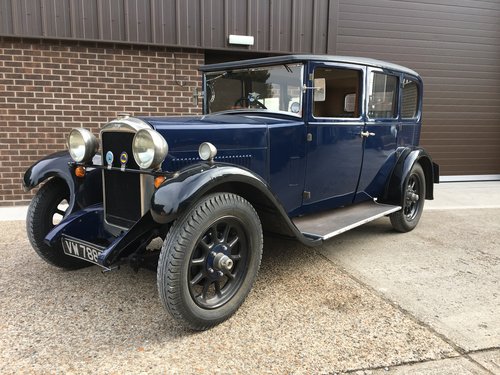


1928 HILLMAN FOURTEEN SIX LIGHT
Built in late 1928 and first registered on the 9th January 1929. This car has a 1954cc, 4 cylinder engine and was one of the first models produced by Hillman, after Rootes Brothers purchased the company from William Hillman in 1928.


‘Henry’ still sports it’s original blue leather interior and has a right-hand gear change and handbrake levers obstructing the driver’s door. Entry/Exit should be from passenger side and then sliding across (very elegant)

This particular car was originally purchased by a gentleman in Chadwell Heather, Essex for the princely sum of £375.

Comes with a copy of the original owner’s handbook presented nicely in a leather bound folder.

‘Features of the new Fourteen’

Low to the ground. With its wide track and low centre of gravity, the new ‘Fourteen’ has remarkable stability and cornering qualities at all speeds; a result that has been obtained without any sacrifice of clearance, which is ample for all conditions, either at home or abroad . The lowering of the frame and flattening of the springs have allowed the mounting of body-work which, besides being unusually spacious, has that graceful low outline which stamps it as of the most modern design.

Good to drive and ride in. Hillman performance has always been outstanding. In the new model it is even better than before. A number of detail modifications have made the engine even more durably efficient, quieter and smoother at all speeds. There are improvements in the transmission; the radiator is bigger and deeper; the controls are neater; the instrument board is more attractive and is indirectly lighted; the four wheel brakes have been increased in power; the seats are wide; and the running boards are lower. Shock absorbers are fitted all round. To the many to whom comfort is of primary importance, the new Hillman will make and instant appeal. never before has such accommodation have achieved with so moderate a wheelbase.

Good to look at. The pride an owner takes in his car depends not a little on appearance. the Hillman looks what it is, the very best and most advanced examples its type. In all new Hillman bodies (other than Fabric models), pressed steel panels with integral mouldings are used throughout and form a perfect base for the cellulose finish. The new colour-schemes are particularly attractive – they are dignified and in every way appropriate to a product of exclusive quality. The fabric saloon and Segrave models are of genuine Weymann construction, which is admittedly the finest body of its type. The appearance of the Hillman Fourteen pleases they as much as its comfort and performance please its occupants on the road.

Viewing by appointment only, please note; the car is not stored in our Woodbridge workshops. Finance can be arranged by a third party. Office hours are Monday to Friday (Saturdays and Sundays can be arranged) 8am to 5pm. If you would like to know more then please call Craig on 01473 742038.


SELECTED BY:
IDRIS THE SQUIRREL
I'M NUTS ABOUT CLASSICS
Disclaimer:  Whilst Classic Chatter ("we") attempt to make sure that the information contained in this website is accurate and complete, we are aware that some errors and omissions may occur from time to time. We are not able, therefore, to guarantee the accuracy of that information and cannot accept liability for loss or damage arising from misleading information or for any reliance on which you may place on the information contained in this website. We highly recommend that you check the accuracy of the  information supplied. If you have any queries with regard to any information on our website, please contact us at  jeff.classicchatter@mail.com


CLASSIC CHATTER
Powered by Dragons

Friday, 6 July 2018

1928 Hispano Suiza H6C "Boulogne" - CHARLES PRINCE

CLASSIC CHATTER
By Enthusiasts For Enthusiasts
Visit our 2018 Events Listings at 
EVENTS 2018 
To Advertise your 2018 Events 
 e-mail us at:
events.classicchatter@mail.com
^^^^^^^^^^^^^^^^^^^^^^^^^^^^^^^^^^^^^^^^^^^^^^^^^^^^^^^^^^^^
Social Media
FACEBOOK - @classicchatterinfocus
TWITTER - @classicchat
+++++++++++++++++++++++++++++++++++++++++++++++++++++
CLASSIC + SPORTSCAR SHOWROOM

TODAY WE FEATURE
CHARLES PRINCE
Telephone +44 (0) 79 85 98 80 70


1928 Hispano Suiza H6C "Boulogne"
Chassis No:12400
Engine No: 320387
Engine: 6 Cylinder 7983cc
Gearbox: 3 Speed

In 1919, having built a reputation for manufacturing some of the finest aero engines, Hispano Suiza's lead engineer, Marc Birkigt, from Switzerland turned his attention to motorcar design. The first model produced after World War 1 was the 6.5 Litre H6B. It was without doubt technically the most advanced car in the world. Many of the cars produced carried elaborate formal coachwork. The smooth and powerful engine, superb transmission, brakes and steering, combined with the excellent chassis provided a perfect platform to build such cars.


The H6B chassis in shortened form was also used for competition and was very successful. One of the most famous results was at the prestigious Georges Boillot Cup held in 1922 at Boulogne. The factory prepared 5 short chassis cars, with a slightly enlarged engine. The outright victory was the result for Ballot and a second for André Dubonnet. In 1923 the same result was obtained using the 8 Litre H6C Chassis.


Dubonnet entered one of the 1922 cars for the 400km race at Monza, winning the larger class. The short chassis cars were also raced at Indianapolis with great success. Over the years there has been some confusion and argument among motoring historians as to exactly when the epithets "Monza" and "Boulogne" came to be used for the competition cars, which applied to which engine size. One of the most respected experts was none other but "Jabby" Crombac, the highly respected Formula One journalist who worked for Autosport and launched Sport-Auto in France.


This car was originally supplied with a very light and sporting skiff coachwork by Labourdette to Suzanne Deutsche de la Meurthe. She was Henry Deutsche de la Meurthe’s daughter. Henry was one of the richest men in Europe. His company, Jupiter Oils, merged with Shell to become Shell France. Henry founded the Automobile Club de France with the Count of Dion (of De Dion Bouton fame.) Suzanne had a great passion for aviation and was instrumental in rebuilding the aero industry in France after WW11. Both her father and she received the Legion D’ Honneur. 


“Jabby” Crombac purchased this car in the late 1950's and proceeded with an exciting project to restore the car as short chassis competition model. None of the original racing cars existed, but with the help of an experienced ex Hispano factory engineer, he obtained some original Hispano competition department parts, including the shortened prop shaft. Crombac's work was completed with help from Louis Rossigneux the Hispano factory engineer mentioned earlier and John Bolster the highly respected British motoring journalist. Rossigneux fitted an uprated camshaft, back axle and carried out other performance modifications. The result is a car which is capable of 120MPH


KEEPING IT CLASSIC
2010-2018
Disclaimer:  Whilst Classic Chatter ("we") attempt to make sure that the information contained in this website is accurate and complete, we are aware that some errors and omissions may occur from time to time. We are not able, therefore, to guarantee the accuracy of that information and cannot accept liability for loss or damage arising from misleading information or for any reliance on which you may place on the information contained in this website. We highly recommend that you check the accuracy of the  information supplied. If you have any queries with regard to any information on our website, please contact us at  jeff.classicchatter@mail.com


Sunday, 12 October 2014

1928 MORRIS COWLEY SALOON - BILL POSTINS

"CLASSIC OF THE DAY"
 1928 MORRIS COWLEY SALOON
 
The Morris Cowley and its de-luxe brother the Oxford were so successful in the mid-1920s that William Morris was obliged to institute three shift working and acquire the Hotchkiss factory in Coventry in order to satisfy demand. The basic design of the Cowley dates to the period before the Great War, but there was always a continuous process of development, notably the introduction of balloon tyres, improved engines, electric lighting and starting and finally optional front wheel brakes in 1926. The engine is the 1548cc four-cylinder side-valve Morris unit, with three main bearings and Lucas magneto ignition, coupled via a wet plate clutch to a three speed gearbox.
The example we offer here was first registered in Somerset on 7th of August 1928.Furthermore, according to the last owner and the 1942 Buff log book, the car appears to have had just 4 owners from new, changing hands just 3 times since 1965.

The car has obviously been subject to an earlier restoration. Recently fitted with new carpets. The Morris rides on period artillery wheels.
Finished in cream the Cowley would make an ideal wedding car.

We are more than happy to entertain a part exchange with if needs be for a more valuable car ie. cash either way.

Please call me on 01676 533949 for an appointment to view.
 
 Bill Postins Motor Trade career spans 49 years, commencing in the late 50s training with the Kenning Motor Group. A major player at the time in the British Motor Corporation's dealer network. Bill Postins actually sold the very first MGB in Warwickshire.
 
Source: BILL POSTINS
 
 
SNIPPETS:
 
Morris Cowley (Flatnose) (1926–1931) - 201,692 made
Body style 2 and 4 seat tourer, coupé, 4-door saloon, folding head saloon (1930).
Engine 1548 cc side-valve Straight-4
Wheelbase 102 inches, Length 150 inches, Width 58.5 inches
The Bullnose radiator was replaced by a flat version in 1926 in a new version of the car with all steel bodies becoming available. The engines remained the same, but the Cowley unlike the Oxford, retained braking on the rear wheels only as standard, although a front brake system was available at extra cost (featured car has this fitted). The chassis was new and the suspension was updated with semi elliptic leaf springs all round plus Smiths friction type scissor shock absorbers. The brakes are rod and spring operated with cams inside the drums to actuate. Interesting to note that the rear brake drums include two sets of shoes, one of which is connected directly to the handbrake.
The chassis was further modified in 1931 to bring it in line with the Morris Major. Wire wheels became an option instead of the solid spoked artillery ones previously fitted.

Source: http://www.gracesguide.co.uk/Morris:_Flatnose